

Introduction
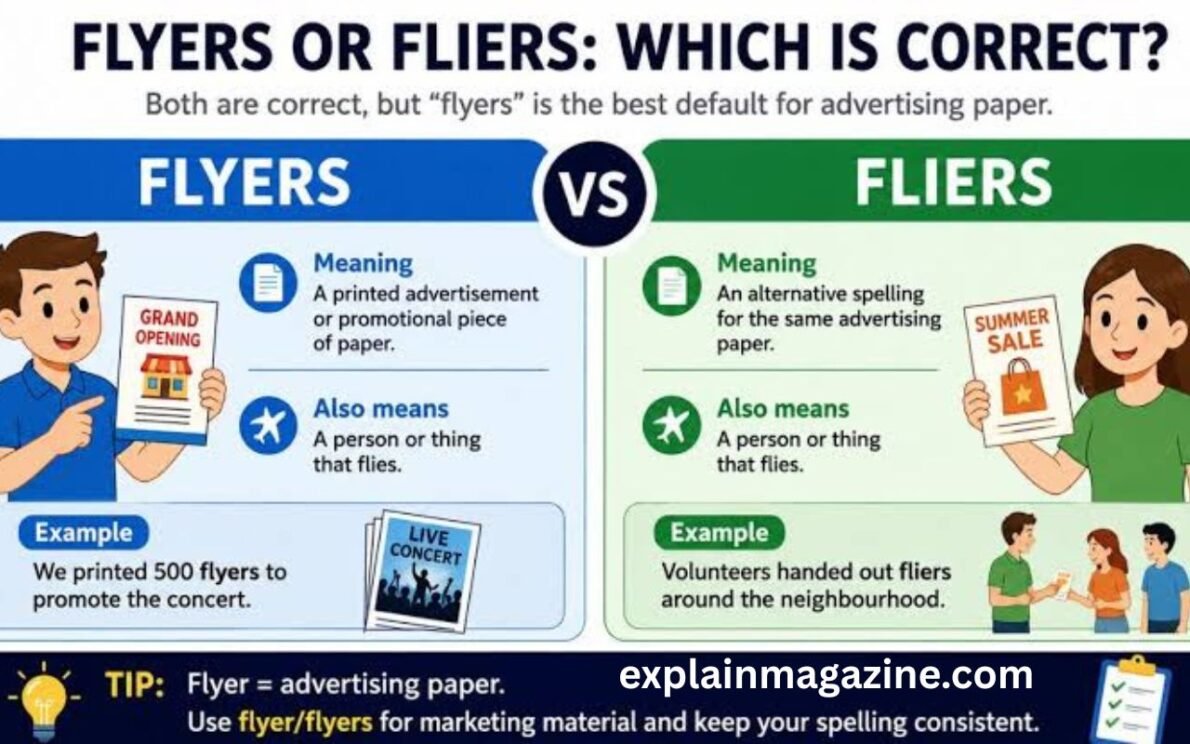
The debate over flyers or fliers has confused writers, students, marketers, business owners, and English learners for years. Since both spellings appear in dictionaries, newspapers, advertisements, and online content, many people wonder which version is actually correct.
If you are creating promotional materials, printing advertisements, or writing business content, choosing the proper spelling can improve clarity and professionalism. While both words are accepted in English, modern usage generally favors flyers for advertising materials and printed handouts. However, fliers remains a valid alternative and is still used in certain contexts, particularly when referring to people or things that fly.
This guide explains the meaning, spelling, usage, plural forms, and common phrases involving flyers and fliers so you can confidently choose the correct word.
Quick Bio Table
| Topic | Details |
|---|---|
| Word | Flyer / Flier |
| Plural Forms | Flyers / Fliers |
| Part of Speech | Noun |
| Most Common Spelling | Flyer / Flyers |
| Meaning | Advertisement, leaflet, or a person who flies |
| Preferred for Paper Ads | Flyers |
| Accepted Alternative | Fliers |
| Business Usage | Flyers |
| Common Travel Phrase | Frequent Flyer |
| UK Usage | Flyer more common |
Flyers or Fliers: Which Is Correct?
The simple answer is that both flyers and fliers are correct spellings. Neither word is considered a grammatical error.
However, modern English usage has developed a preference:
- Flyers is most commonly used for printed advertisements, promotional leaflets, and marketing handouts.
- Fliers is often used for people, animals, or objects that fly, though it can still refer to advertisements in some contexts.
Because of this distinction, most businesses, marketers, and publications use flyers when referring to promotional paper materials.
Flyers or Fliers Meaning
Both words share similar meanings.
A flyer or flier may refer to:
- A printed advertisement
- A promotional leaflet
- A handout distributed to the public
- A person who travels by airplane
- A pilot or aviator
- Something capable of flying
The exact meaning depends on context.
Examples
- The company printed flyers for its grand opening.
- Volunteers handed out flyers around the neighborhood.
- She is a frequent flyer with the airline.
- Eagles are powerful fliers.
Is It Flyers or Fliers for Paper?
One of the most searched questions is:
“Is it flyers or fliers for paper?”
When referring to printed promotional sheets, advertisements, event notices, or business handouts, flyers is the preferred spelling.
Examples:
- We distributed paper flyers at the event.
- The business printed 5,000 flyers.
- The school created flyers for the fundraiser.
Although paper fliers is technically correct, most readers expect to see paper flyers instead.
Paper Flyers or Fliers
In marketing and advertising industries, the term paper flyers is significantly more common.
Paper flyers are often used for:
- Business promotions
- Restaurant advertisements
- Event announcements
- Political campaigns
- Community notices
- Product launches
Because the advertising industry overwhelmingly favors “flyer,” most professional printers and designers also use the spelling flyers.
Advertising Flyers or Fliers
Both expressions are understandable:
- Advertising flyers
- Advertising fliers
However, advertising flyers is the standard phrase used by businesses and marketers.
Examples:
- The company distributed advertising flyers downtown.
- We designed advertising flyers for the new product launch.
- Promotional flyers helped increase attendance at the event.
For branding consistency and professional communication, most organizations choose flyers.
Business Flyers or Fliers
Businesses almost always use flyers when discussing printed marketing materials.
Common business uses include:
- Sales flyers
- Promotional flyers
- Real estate flyers
- Event flyers
- Retail flyers
- Restaurant flyers
Examples:
- The marketing team created business flyers for the campaign.
- Local stores distributed flyers with discount coupons.
- The startup used flyers to attract new customers.
In professional settings, business flyers is the safest and most recognizable choice.
Pass Out Flyers or Fliers
When promoting an event or business, people often ask:
Should I say pass out flyers or pass out fliers?
Both are correct, but pass out flyers is the more common phrase.
Examples:
- Volunteers passed out flyers at the concert.
- Staff members passed out flyers outside the mall.
- Students passed out flyers for the charity drive.
The phrase sounds more natural to most English speakers when using flyers.
Hand Out Flyers or Fliers
The same rule applies to the phrase hand out flyers.
Examples:
- We handed out flyers during the trade show.
- The campaign team handed out flyers across the city.
- Employees handed out flyers promoting the new service.
While “hand out fliers” is acceptable, “hand out flyers” remains the preferred form in business and advertising contexts.
Frequent Flyers or Fliers
Travel terminology creates a slightly different situation.
The phrase frequent flyer is widely used by airlines and loyalty programs.
Examples:
- Frequent flyer miles
- Frequent flyer program
- Frequent flyer rewards
Some publications may use frequent flier, but frequent flyer is far more common and recognizable.
Examples
- She earned enough frequent flyer miles for a free ticket.
- Frequent flyer programs reward loyal travelers.
- Many business travelers become frequent flyers.
Correct Spelling of Flyers or Fliers
Since dictionaries recognize both spellings, the question is not about right versus wrong.
Instead, it is about preference and context.
| Context | Recommended Spelling |
|---|---|
| Paper Advertisements | Flyers |
| Marketing Materials | Flyers |
| Business Promotions | Flyers |
| Event Handouts | Flyers |
| Airline Travelers | Flyer or Flier |
| Birds and Flying Objects | Flier or Flyer |
| General Writing | Flyers |
If you are uncertain, flyers is usually the safest choice.
Flyers or Fliers Plural
The plural forms depend on the spelling you choose.
Singular to Plural
- Flyer → Flyers
- Flier → Fliers
Examples:
- The flyer looked professional.
- The flyers attracted many customers.
- The flier boarded the aircraft.
- The fliers completed the journey safely.
Both plural forms are grammatically correct.
Why Do People Confuse Flyers and Fliers?
There are several reasons:
Same Pronunciation
Both words are pronounced exactly the same way.
Shared Meanings
They can both refer to:
- Advertisements
- Travelers
- Flying objects
Historical Usage
English developed both spellings over time, and dictionaries continue to recognize each form.
Style Guide Differences
Different organizations and publishers may favor one spelling over the other.
Which Spelling Should You Use?
For most modern writing, especially online content, marketing materials, educational resources, and business communication, flyers is the preferred choice.
Choose flyers when discussing:
- Paper advertisements
- Marketing campaigns
- Business promotions
- Event notices
- Printed handouts
Choose fliers only when a specific style guide prefers it or when discussing people or things that fly in a more traditional context.
Final Thoughts
Read More: Pricey or Pricy: Which Spelling Is Correct and What Does It Mean?
The question of flyers or fliers does not have a simple right-or-wrong answer because both spellings are accepted in English. However, modern usage strongly favors flyers for paper advertisements, business promotions, event handouts, and marketing materials. While fliers remains a valid alternative, it appears less frequently in professional and commercial writing.
For businesses, marketers, students, bloggers, and content creators, using flyers is generally the best choice because it aligns with modern language expectations and industry standards. At WorldKnowledge, our goal is to make confusing English language topics easier to understand so readers can write with greater confidence and accuracy.