
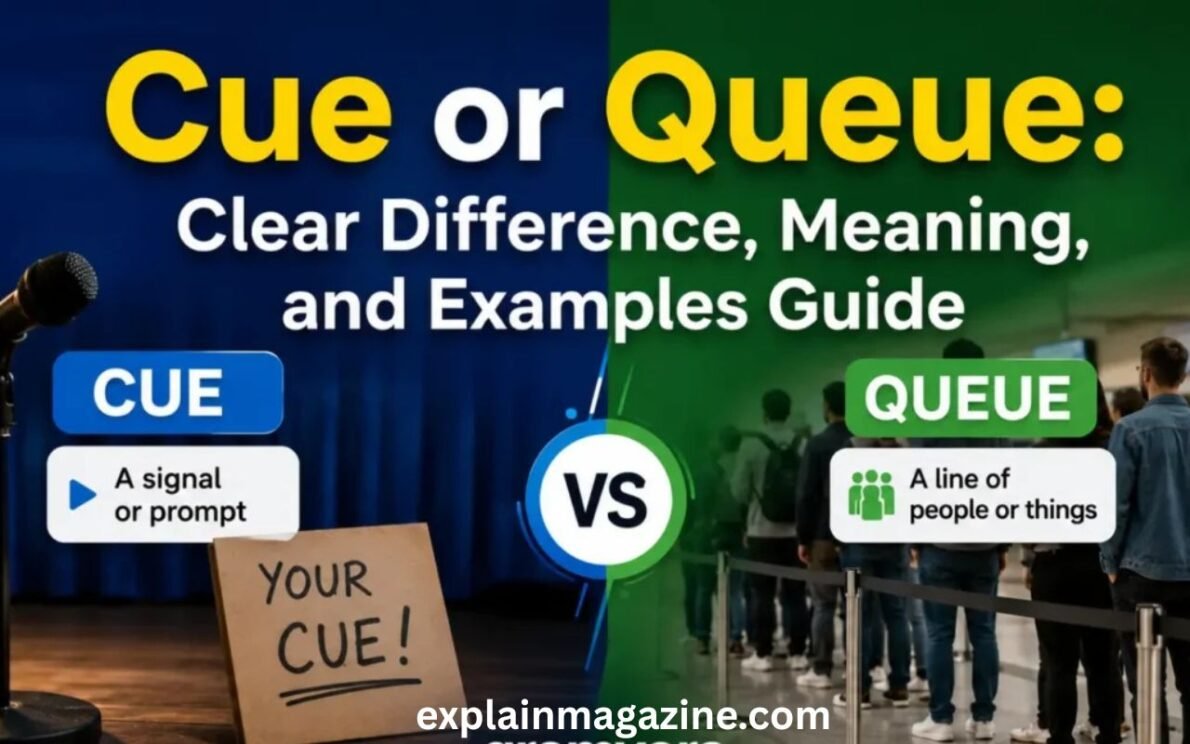

English contains many words that sound exactly alike but have completely different meanings. One of the most common examples is cue and queue. Because both words are pronounced the same way, many writers struggle to decide which spelling is correct in phrases such as “right on cue or queue,” “that’s your cue or queue,” “cue or queue the music,” and “waiting in the cue or queue.” While these words may sound identical, they serve very different purposes in English grammar and communication.
The good news is that once you understand the meanings of cue and queue, choosing the correct word becomes much easier. Cue generally relates to signals, prompts, hints, or indications that tell someone when to act. Queue usually refers to a line of people, tasks, calls, or items waiting for their turn. Understanding this distinction can help you avoid common spelling mistakes and improve both your writing and speaking skills. Grammar experts, dictionaries, and language guides consistently emphasize that context determines which word should be used.
Quick Bio Table
| Topic | Details |
|---|---|
| Main Keyword | Cue or Queue |
| Word Type | Homophones |
| Meaning of Cue | Signal, prompt, hint, indication |
| Meaning of Queue | Line, waiting sequence, ordered list |
| Correct Phrase | Right on Cue |
| Correct Phrase | That’s Your Cue |
| Correct Phrase | Cue the Music |
| Correct Phrase | Wait in the Queue |
| Common Confusion | Same pronunciation |
| English Usage | Both British and American English |
What Is the Difference Between Cue and Queue?
The primary difference lies in meaning.
A cue is a signal, prompt, indication, or hint that tells someone when to do something. It is commonly used in theater, television, music, sports, and everyday communication.
A queue is a line of people or things waiting for their turn. It can refer to a physical line of people at a store or an electronic list of calls, files, or tasks waiting to be processed.
Examples:
- The actor waited for his cue before entering the stage.
- We stood in a long queue outside the stadium.
Although they sound the same, their meanings are entirely different.
Is It Cue or Queue?
This is one of the most searched grammar questions.
The answer depends on context.
Use cue when referring to:
- A signal
- A prompt
- A hint
- An indication
- A trigger for action
Use queue when referring to:
- A waiting line
- An ordered sequence
- Calls waiting for service
- Computer tasks awaiting processing
- People waiting for their turn
A simple rule is:
Cue starts action. Queue waits for action.
Right on Cue or Queue
The correct expression is:
Right on Cue
This phrase means something happens exactly when expected or at the perfect moment.
Examples:
- Right on cue, the rain started falling.
- Right on cue, the lights went out.
- Right on cue, the guest arrived.
The phrase comes from theatrical performances where actors respond to cues that tell them when to speak or move.
“Right on queue” is incorrect because queue refers to a waiting line, not timing or signals.
That’s Your Cue or Queue
The correct phrase is:
That’s Your Cue
This means:
- It is your signal to begin.
- It is your moment to act.
- It is time for you to do something.
Examples:
- The host finished speaking. That’s your cue.
- The music started. That’s your cue to dance.
- The teacher called your name. That’s your cue to enter.
Because the phrase refers to a signal, cue is always correct.
That’s My Cue or Queue
The correct expression is:
That’s My Cue
Examples:
- That’s my cue to leave.
- That’s my cue to start working.
- That’s my cue to begin the presentation.
The phrase means a situation has provided the signal or reason for taking action.
Using queue here would be incorrect because the meaning involves a prompt rather than a line.
Cue or Queue the Music
This phrase often causes confusion because both words can technically relate to music.
Cue the Music
This is the most common expression.
It means:
- Start the music.
- Signal the music to begin.
- Prepare the music to play at the correct moment.
Examples:
- Cue the music for the performance.
- The director told the technician to cue the music.
Queue the Music
This can also be correct in a different context.
It means:
- Add music to a playlist.
- Place songs into an ordered list for future playback.
Examples:
- Queue the music for tomorrow’s event.
- Queue these songs in the playlist.
Most people asking “cue or queue the music” are referring to starting music, so cue the music is usually the correct choice.
In the Cue or Queue
When referring to waiting, the correct expression is:
In the Queue
Examples:
- I am in the queue for customer service.
- Your request is in the queue.
- We stood in the queue for tickets.
A queue refers to an ordered line or sequence.
“In the cue” is rarely correct because cue generally does not mean a line.
Waiting in the Cue or Queue
The correct phrase is:
Waiting in the Queue
Examples:
- We spent an hour waiting in the queue.
- Customers were waiting in the queue.
- There was a long queue at the airport.
British English commonly uses the word queue for waiting lines, while American English often uses the word line. Nevertheless, queue remains correct in both varieties of English.
Social Cue or Queue
The correct expression is:
Social Cue
A social cue is a signal that helps people understand emotions, intentions, or expected behavior.
Examples:
- Facial expressions are important social cues.
- Eye contact can be a social cue.
- Body language provides social cues during conversations.
Because these are signals or indicators, cue is the correct spelling.
Call Cue or Queue
In customer service and telecommunications, the correct term is usually:
Call Queue
A call queue is a system that places callers in an ordered waiting list until an agent becomes available.
Examples:
- Your call is in the queue.
- The support center manages a large call queue.
If referring to a signal to begin a call, cue could be used, but in business and technology environments, queue is much more common.
Work Cue or Queue
The correct word depends on meaning.
Work Cue
Used when referring to a signal or reminder.
Example:
- The notification served as a work cue.
Work Queue
Used when referring to tasks waiting to be completed.
Example:
- The manager assigned tasks to the work queue.
In business environments, work queue is generally more common because it refers to pending assignments.
Phone Cue or Queue
The correct expression is usually:
Phone Queue
Examples:
- Customers entered the phone queue.
- The phone queue was unusually long.
This refers to callers waiting for assistance.
Cue would only apply if a signal was involved.
Visual Cue or Queue
The correct phrase is:
Visual Cue
A visual cue is something seen that communicates information or signals an action.
Examples:
- Traffic lights provide visual cues.
- The sign acted as a visual cue.
- Facial expressions serve as visual cues.
Because the meaning involves signals and indications, cue is correct.
Common Mistakes to Avoid
Incorrect:
- Right on queue
- That’s your queue
- Take my queue
- Social queue
- Visual queue
Correct:
- Right on cue
- That’s your cue
- Take my cue
- Social cue
- Visual cue
Incorrect:
- Waiting in the cue
- Join the cue
- Call cue
Correct:
- Waiting in the queue
- Join the queue
- Call queue
Learning these common expressions helps eliminate confusion.
How to Remember the Difference
Use this simple memory trick:
Cue = Signal
Think:
- Cue card
- Cue actor
- Cue music
- Visual cue
- Social cue
Queue = Line
Think:
- Ticket queue
- Call queue
- Work queue
- Phone queue
- Waiting queue
If something tells you to act, choose cue.
If something waits in order, choose queue.
Final Thoughts
Read More: That or Which: When to Use Each Word Correctly in English Grammar
The difference between cue and queue is simpler than it first appears. Cue refers to a signal, prompt, hint, or indication that triggers action, while queue refers to a line or ordered sequence waiting for its turn. This is why expressions such as “right on cue,” “that’s your cue,” “take my cue,” and “social cue” use cue, while phrases such as “wait in the queue,” “call queue,” “phone queue,” and “work queue” use queue. Once you connect cue with signals and queue with lines, choosing the correct spelling becomes straightforward.
For writers, students, professionals, and English learners, understanding this distinction can improve grammar accuracy and confidence. At worldknowledge, we aim to make confusing English language topics easier to understand through clear explanations and practical examples that readers can use every day.