
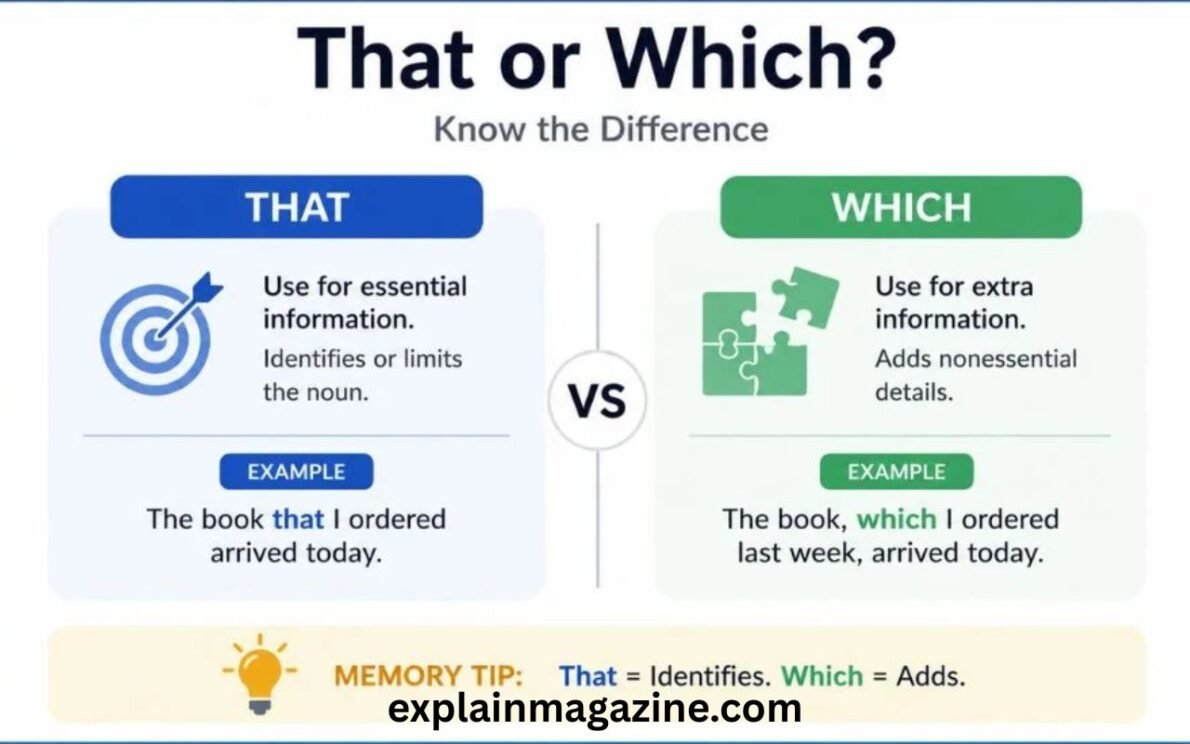

Many English learners and even native speakers struggle with the difference between that and which. Because both words can introduce additional information about a noun, they are often used interchangeably in everyday conversation. However, grammar rules and style guides explain that these words serve different purposes, especially in formal writing. Understanding the distinction can improve clarity, prevent grammatical errors, and make your writing more professional.
One of the most common questions in English grammar is, “When should I use that or which?” The answer depends on whether the information you are adding is essential to the meaning of the sentence or simply extra information. While the distinction may seem small, it can significantly affect how readers understand your message. This guide explains the grammar rules, usage patterns, examples, punctuation requirements, and differences between American and British English to help you use these words correctly.
Quick Bio Table
| Topic | Details |
|---|---|
| Main Keywords | That or Which |
| Word Type | Relative Pronouns |
| Purpose of “That” | Introduces essential information |
| Purpose of “Which” | Introduces nonessential information |
| Comma Before “That” | Usually No |
| Comma Before “Which” | Usually Yes |
| Common Usage | Grammar and Formal Writing |
| British English | More flexible usage |
| American English | Clear distinction preferred |
| Difficulty Level | Beginner to Intermediate Grammar |
What Is the Difference Between That and Which?
The primary difference between that and which involves the type of clause they introduce.
That introduces a restrictive clause. A restrictive clause contains information that is necessary to identify the noun being discussed.
Example:
- The laptop that I bought yesterday is already broken.
In this sentence, “that I bought yesterday” identifies which laptop is being discussed. Without that information, the meaning becomes unclear.
Which introduces a nonrestrictive clause. A nonrestrictive clause provides extra information that is not necessary for identifying the noun.
Example:
- The laptop, which I bought yesterday, is already broken.
In this sentence, the listener already knows which laptop is being discussed. The phrase “which I bought yesterday” simply adds additional information.
Understanding this distinction forms the foundation of correct usage.
When to Use That
Use that when the information is essential to the meaning of the sentence.
If removing the clause changes the meaning or makes the sentence unclear, use that.
Examples:
- The book that won the award became a bestseller.
- Students that study regularly often perform better.
- The restaurant that serves Italian food is nearby.
- The car that has the flat tire belongs to Sarah.
In each example, the clause introduced by “that” identifies exactly which person, thing, or place is being discussed.
Characteristics of “That”
- Introduces essential information
- Usually does not require commas
- Common in formal and informal writing
- Frequently used in restrictive clauses
When to Use Which
Use which when adding information that is interesting but not necessary for identifying the noun.
Examples:
- My car, which is ten years old, still runs well.
- The museum, which attracts thousands of visitors annually, is located downtown.
- The movie, which received several awards, became a box-office success.
In these examples, removing the “which” clause would not change the core meaning of the sentence.
Characteristics of “Which”
- Introduces additional information
- Usually requires commas
- Common in descriptive writing
- Used in nonrestrictive clauses
The That or Which Rule
One of the simplest grammar rules is:
Use “that” for essential information and “which” for extra information.
Consider the following pair of sentences:
Example 1
- Dogs that bark loudly can disturb neighbors.
This means only certain dogs are being discussed.
Example 2
- Dogs, which bark loudly, can disturb neighbors.
This suggests barking loudly is simply additional information about dogs in general.
The placement of the relative pronoun changes the meaning.
That or Which in a Sentence
Learning through examples makes the distinction easier to understand.
Correct Use of That
- The teacher that helped me inspired my career.
- The phone that I lost has been found.
- The shoes that fit best are on sale.
- The employee that completed the project received recognition.
Correct Use of Which
- The teacher, which many students admired, retired last year.
Note that when referring to people, “who” is generally preferred over “which.”
Better version:
- The teacher, who many students admired, retired last year.
Other examples:
- The building, which was constructed in 1900, remains standing.
- The park, which covers hundreds of acres, attracts many visitors.
Comma Before That or Which
Punctuation is often the easiest clue for choosing the correct word.
Comma Before That
Generally, no comma appears before “that.”
Examples:
- The house that sits on the corner is for sale.
- The book that I borrowed is overdue.
Comma Before Which
A comma usually appears before “which” when introducing a nonessential clause.
Examples:
- The house, which sits on the corner, is for sale.
- The book, which I borrowed yesterday, is overdue.
Remember:
- No comma = usually “that”
- Comma = usually “which”
This guideline helps many writers avoid mistakes.
That or Which in Formal Writing
Formal writing often follows stricter grammar conventions.
Academic papers, business documents, legal writing, and professional reports typically distinguish clearly between “that” and “which.”
Formal Example
- The policy that governs employee conduct was updated.
Formal Example with Which
- The policy, which was updated recently, governs employee conduct.
Using the correct relative pronoun helps improve readability and precision.
Many editors specifically check for proper “that” and “which” usage during proofreading.
English Grammar: When to Use That or Which
A useful method is to ask yourself a simple question:
Is the information necessary?
If yes, use that.
Example:
- The cake that contains nuts should be avoided.
Without the clause, readers would not know which cake.
Is the information additional?
If yes, use which.
Example:
- The cake, which contains nuts, should be avoided.
The identity of the cake is already known.
This test works in most situations.
That or Which Examples
Here are additional examples demonstrating correct usage.
Restrictive Clauses Using That
- The movie that won the award was excellent.
- The student that answered correctly earned extra credit.
- The package that arrived today contains office supplies.
- The apartment that overlooks the river is expensive.
Nonrestrictive Clauses Using Which
- The movie, which won several awards, was excellent.
- The package, which arrived today, contains office supplies.
- The apartment, which overlooks the river, is expensive.
- The city, which has a rich history, attracts tourists.
These comparisons highlight how sentence meaning changes based on the chosen word.
That or Which in British English
British English is generally more flexible regarding “that” and “which.”
In British usage, writers sometimes use “which” even in restrictive clauses.
Example:
- The car which I bought last year is reliable.
This sentence is acceptable in British English.
However, many modern style guides still recommend using “that” for restrictive clauses because it improves clarity.
American English tends to follow the distinction more strictly.
British English Example
- The house which stands on the hill is visible from miles away.
American English Preference
- The house that stands on the hill is visible from miles away.
Both versions may be understood, but the American style favors “that.”
Common Mistakes to Avoid
Mistake 1: Using Which Without Commas
Incorrect:
- The laptop which I bought yesterday is broken.
Preferred American English:
- The laptop that I bought yesterday is broken.
Mistake 2: Using That With Nonessential Information
Incorrect:
- My car, that is ten years old, still runs perfectly.
Correct:
- My car, which is ten years old, still runs perfectly.
Mistake 3: Ignoring Context
Always determine whether the information is essential or additional before choosing the word.
Can Grammar Checkers Detect That or Which Errors?
Many grammar tools can identify incorrect usage.
Modern grammar checkers often analyze sentence structure and recommend replacing “which” with “that” or vice versa. However, automated tools are not perfect and occasionally miss context-specific cases.
The best approach is to understand the rule yourself rather than relying entirely on software.
Tips for Remembering the Difference
Here are some simple memory tricks:
- That = Necessary Information
- Which = Additional Information
- That = No Comma
- Which = Usually Comma
Whenever you are unsure, remove the clause from the sentence.
If the sentence loses its meaning, use that.
If the sentence still makes sense, use which.
This technique works in most writing situations.
Conclusion
Read More: Utmost or Upmost: Which Word Is Correct and When Should You Use It?
Understanding the difference between that and which is one of the most valuable grammar skills for English writers. Although the two words appear similar, they serve distinct purposes. “That” introduces essential information that identifies a noun, while “which” introduces additional information that can be removed without changing the main meaning of the sentence. Paying attention to commas, sentence structure, and context will help you choose the correct word confidently.
Whether you are writing emails, essays, business reports, or website content, mastering this rule can make your communication clearer and more professional. At worldknowledge, we believe that learning practical grammar rules like the distinction between “that” and “which” can significantly improve writing quality and confidence.