
Many English learners, students, writers, and professionals frequently ask the same question: Is it invision or envision? Because both words sound almost identical when spoken, it is easy to assume they are interchangeable. This confusion has become even more common in recent years due to the popularity of the design software brand InVision.
However, when it comes to standard English grammar, the answer is surprisingly straightforward. One word is officially recognized and widely used in dictionaries, academic writing, business communication, and everyday English. The other is generally considered a misspelling except when used as a company name.
Understanding the difference between “invision” and “envision” can improve your writing, help you avoid common spelling mistakes, and ensure your communication appears professional and accurate. In this guide, we will explore the meaning of envision, why people mistakenly use invision, how to use the correct term, and practical examples that make the distinction easy to remember.
Quick Bio Table
| Detail | Information |
|---|---|
| Correct Word | Envision |
| Incorrect/Common Misspelling | Invision |
| Part of Speech | Verb |
| Meaning | To imagine, visualize, or picture mentally |
| Dictionary Recognition | Envision only |
| Used in Formal Writing | Yes |
| Used in Academic Writing | Yes |
| Used in Business Communication | Yes |
| Exception | InVision (software brand name) |
| Common Confusion Reason | Similar pronunciation |
Is It Invision or Envision?
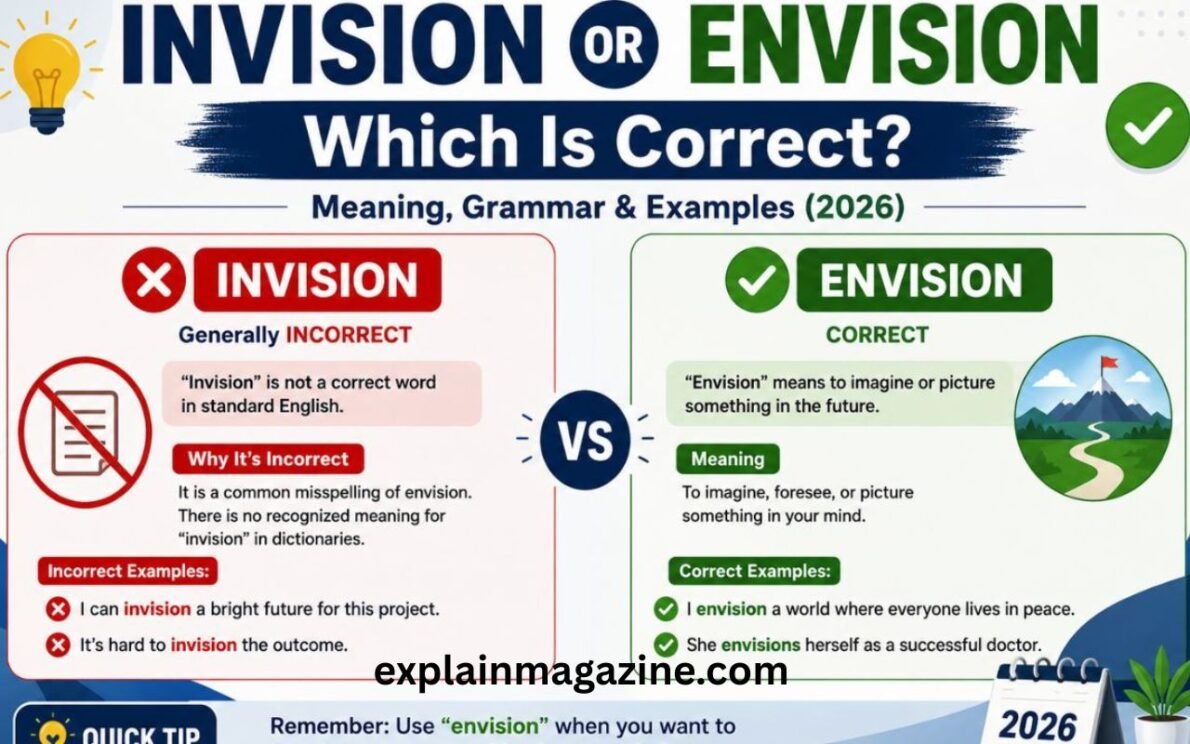
The correct word is envision.
If you are trying to express the idea of imagining, visualizing, forecasting, or mentally picturing something, envision is the proper spelling. Major grammar references and language guides consistently recognize envision as the standard English verb. Meanwhile, invision is generally considered a spelling error unless it refers specifically to the software company InVision.
Examples:
- I envision a successful future.
- She envisions opening her own business.
- The company envisions expanding globally.
These examples are grammatically correct. Replacing envision with invision would create a spelling mistake.
What Does Envision Mean?
The word envision means to imagine, visualize, foresee, or mentally picture something that is not yet a reality.
People commonly use envision when discussing:
- Future goals
- Personal dreams
- Business plans
- Creative ideas
- Long-term strategies
- Possible outcomes
At its core, envision refers to creating a mental image of a future situation or possibility. Language experts describe it as the act of picturing something clearly in your mind before it happens.
Examples of Envision
- I envision a world powered by renewable energy.
- The architect envisioned a modern city skyline.
- She envisioned herself becoming a successful entrepreneur.
- Scientists envision major breakthroughs in medicine.
In each example, envision refers to mentally seeing or imagining a future scenario.
What Does Invision Mean?
In standard English, invision is not recognized as a valid word.
Most dictionaries do not include invision as an accepted alternative spelling of envision. As a result, when people write invision, they are usually making a spelling mistake.
There are several reasons why this error occurs:
- The word sounds similar to envision.
- Many English words begin with the prefix “in.”
- Fast typing can lead to spelling errors.
- The popularity of the InVision software brand causes confusion.
Outside of brand-related contexts, invision should generally be avoided in professional and academic writing.
Why Is Envision the Correct Word?
The spelling “envision” follows established English word-formation patterns.
The prefix “en-” commonly appears in verbs that mean to cause, place into, or make something happen.
Examples include:
- Enable
- Encourage
- Enrich
- Empower
- Envision
Language references explain that envision combines the prefix “en-” with the word “vision,” creating the meaning of putting a vision or mental image into your mind.
This is why envision is recognized as the correct English verb.
InVision: The Exception to the Rule
One important exception exists.
InVision is the name of a well-known digital design and collaboration platform. When discussing the software company, the spelling InVision is correct because it is a brand name.
Examples:
- Our design team uses InVision for prototyping.
- InVision helped improve collaboration among designers.
However:
- I envision a successful project. ✔
- I invision a successful project. ✘
Understanding the difference between the brand name and the English verb eliminates most confusion.
Invision or Envision Meaning Explained
Many people believe both words share the same meaning because they sound nearly identical.
In reality:
Envision
Meaning:
- Imagine
- Visualize
- Picture mentally
- Foresee future possibilities
Invision
Meaning:
- No accepted meaning in standard English
- Usually a misspelling
- Occasionally refers to the InVision software brand
This distinction makes it clear which word should be used in writing.
Difference Between Invision and Envision
| Feature | Envision | Invision |
|---|---|---|
| Correct English Word | Yes | No |
| Recognized by Dictionaries | Yes | No |
| Meaning | Imagine or visualize | None in standard English |
| Academic Usage | Yes | No |
| Professional Usage | Yes | No |
| Everyday Usage | Yes | No |
| Brand Name Use | No | Yes (InVision) |
The table highlights why envision should be the preferred choice in almost every situation.
Why Do People Confuse Invision and Envision?
Several factors contribute to the confusion.
Similar Pronunciation
The most common reason is pronunciation. When spoken quickly, envision often sounds like invision, causing writers to spell the word incorrectly.
Influence of Other Words
English includes many words that begin with “in-“:
- Invisible
- Independent
- Incorrect
- Inactive
Because of these familiar patterns, many people assume invision must also be correct.
Brand Recognition
The widespread use of InVision software has increased visual familiarity with the spelling “InVision,” leading some users to assume it is a standard English word.
Typing Habits
Many spelling mistakes occur simply because people type quickly and rely on pronunciation rather than memory.
How to Use Envision Correctly
The easiest rule is simple:
Whenever you mean “imagine” or “visualize,” use envision.
Examples:
- We envision strong growth next year.
- She envisions a rewarding career.
- The organization envisions positive change.
- I envision completing the project successfully.
This rule works in virtually every writing situation.
Envision in Business Writing
Business professionals frequently use envision to discuss future goals and strategies.
Examples:
- Leadership envisions continued expansion.
- The company envisions entering new markets.
- Management envisions long-term success.
Because the word focuses on future possibilities, it appears regularly in corporate reports, strategic plans, and mission statements.
Envision in Academic Writing
Academic writers also use envision when discussing theories, predictions, and future developments.
Examples:
- Researchers envision new applications for artificial intelligence.
- Economists envision long-term market growth.
- Scientists envision future medical innovations.
The formal tone of the word makes it suitable for educational and professional contexts.
Common Mistakes Writers Make
Mistake 1: Using Invision Instead of Envision
Incorrect:
- I invision a better future.
Correct:
- I envision a better future.
Mistake 2: Confusing the Brand with the Verb
Incorrect:
- I use InVision when describing my goals.
Correct:
- I envision my goals.
- I use InVision software for design work.
Mistake 3: Assuming Regional Differences
Some people believe envision is American English while invision is British English.
This is incorrect.
English-speaking countries consistently use envision as the standard spelling.
Easy Trick to Remember
A simple memory trick can help you avoid this mistake forever.
Think:
Envision = Vision
Since the word contains “vision,” remember that envision means putting a vision into your mind.
Another easy reminder is:
If you want a vision, use envision.
This memory trick works for students, writers, and professionals alike.
Frequently Asked Questions
Is it invision or envision?
Envision is the correct spelling.
Is invision a real word?
No. It is generally considered a misspelling unless referring to the InVision software brand.
What does envision mean?
Envision means to imagine, picture, or mentally visualize something.
Can invision be used in formal writing?
No. Formal writing should use envision unless discussing the software company.
Is envision used worldwide?
Yes. The spelling is standard across American, British, Canadian, and Australian English.
Final Thoughts
Read More: Emma Stone Net Worth 2025–2026: Income, Career Earnings, Assets, and Financial Success
The confusion between invision and envision is understandable because the words sound nearly identical when spoken. However, the grammar rule is simple: envision is the correct English word whenever you want to describe imagining, visualizing, or mentally picturing something. Invision, on the other hand, is generally a spelling mistake unless it refers specifically to the InVision software platform.
Whether you are writing emails, academic papers, blog posts, business reports, or social media content, using the correct spelling demonstrates professionalism and clarity. By understanding the meaning, usage, and differences between these terms, you can confidently choose the right word every time. For more grammar guides, language explanations, and educational content, keep exploring WorldKnowledge.